© By Othmar Vohringer
It's not often that I post a video here on Wild Turkey Fever. However, this is a great video especially for the younger generation of hunters that grew up with plenty of wild turkeys. This has not always been the case. There was a time, not so very long ago, where the American wild turkey was headed for extinction. A few concerned hunters founded the National Wild Turkey Federation which has become since the biggest turkey conservation organization in North America with branches in Canada and Mexico.
The video shows the hard work and dedication it took to restore the wild turkey populations. Today thanks to avid turkey hunters and the National Wild Turkey Federation there are more wild turkeys in America, Canada and Mexico then at any time before. Enjoy.

Showing posts with label Conservation. Show all posts
Showing posts with label Conservation. Show all posts
Sunday, April 15, 2012


Tuesday, March 27, 2012
National Wild Turkey Federation investing $215,000 in Missouri projects
© By Othmar Vohringer
 The National Wild Turkey Federation in the leading wild turkey conservation organization in North America. It is safe to say that without the efforts of the NWTF, their many US state and Canadian chapters, the many dedicated volunteers and supporters there would be no more wild turkeys left in the wild. It is to no small thanks to these dedicated people that the North American wild turkey rebounded from the brink of extinction to numbers never seen before.
The following press release has been submitted to me by the NWTF.
The Missouri State Chapter of the National Wildlife Turkey Federation (NWTF) committed $215,000 this year to conservation, education, outreach and other projects in Missouri.
The chapter works diligently to conserve the wild turkey and preserve our hunting heritage.
The largest single commitment is more than $46,000 to fund habitat-related projects including equipment purchases, cost chare projects on private land, and contracted projects on state and federal lands.
The chapter allocated $38,400 to preserve our hunting heritage through its JAKES (Juniors Acquiring Knowledge, Ethics and Sportsmanship), Wheelin' Sportsmen and Women in the Outdoors outreach programs, National Archery in the Schools program, 4-H Shooting Sports, the National FFA Organization and more.
For a detailed list of NWTF Super Fund projects in Missouri, click here.
For more information about the NWTF, call (800) THE-NWTF, visit www.nwtf.org or go to www.facebook.com/theNWTF.
Saturday, March 08, 2008
A good time to honor turkey conservation
© By Othmar Vohringer
It’s spring. The days get longer and warmer as thousands of hunters all over North America feverishly anticipate spring turkey hunting season. The wild turkey is one of North America’s most popular game species, second only to the whitetail deer. Small wonder. With the exception of Alaska, Hawaii and the northern provinces of Canada turkeys number in the millions.
Millions of hunters take it for granted to see these magnificent game birds everywhere they go but not so very long ago, about three generations, the wild turkey was an inch away from total extinction. There have been a few, at best feeble, attempts to restore the turkey. It was not until sometime mid-century when there came a breakthrough as biologists discovered the success of the trap-and-transfer methods. This made it possible to capture birds in locations and transfer them in other suitable habitat. Despite this new method the re-establishing of the wild turkey could be best described as agonizing slow.
In the early 1970’s a few hunters and biologists got together and founded the National Wild Turkey Federation. At the time of the founding the estimated turkey population numbered 1.3 million compared to an estimated 1.5 million turkey hunters the birds were outnumbered. Thanks to the hard work of many volunteers in corporation with state and provincial wildlife agencies, there are now more than 7 million turkeys and nearly 3 million turkey hunters.
The resurrection of the wild turkey population is one of the most successful conservation programs in conservation history. The success continues and keeps showing astounding results. Today we have turkeys roaming the wild, even in areas that traditionally never has been known to hold turkeys. It is no wonder that turkey hunting has become the fasted growing segment with the second highest participation of any type of hunting.
Since 1985 the National Wild Turkey Federation has spent more than 258 million dollars on upholding and promoting the hunting tradition and conserving more than 13.1 million acres of wildlife habitat. The land not only supports wild turkeys but a vast variety of wildlife and flora. The NWTF has today 550.000 members in 50 states, Canada and Mexico plus 14 foreign countries, supporting wildlife management and habitat conservation on public, private, and corporate lands.
So if you head out this spring in the pursuit of a big tom take a moment to remember who you have to be thankful to for the opportunity to go turkey hunting. Or still better yet join the National Wild Turkey Federation and become active in your state or province chapter in the conservation effort of one of the most majestic game birds in North America.
For more information on the National Wild Turkey Federation, check out the NWTF web site or call (800) THE-NWTF.
Tags: National Wild Turkey Federation, Wildlife Conservation, Turkey Hunting
Sunday, October 07, 2007
NWTF Commitment to Hunters’ Rights
In the News.
Source: U.S. Sportsmen’s Alliance
The National Wild Turkey Federation has reached a milestone, having donated more than $1 million to the U.S. Sportsmen’s Alliance and the fight to protect hunting in America.
On Oct. 5 at the Southeastern Outdoor Press Association Conference in Little Rock, Arkansas, National Wild Turkey Federation (NWTF) Senior Vice President of Communications Tammy Sapp presented a $100,000 check to Rick Story, USSA senior vice president. The contribution makes NWTF one of the top donors of all time to the nation’s leading sportsmen’s rights advocacy organization.
“This benchmark speaks volumes about the NWTF and its deep and steadfast commitment to the defense of outdoor sports,” said Bud Pidgeon, USSA president & CEO. “Its investment in the battle to protect sportsmen’s rights has paid dividends for hunters from Maine to California.”
The NWTF and USSA have partnered on many projects to promote and protect hunting. The team, along with the National Shooting Sports Foundation, established the Families Afield program to eliminate unnecessary hunting age restrictions and ease hunter education mandates for first time hunters.
"Removing youth hunting barriers is one way to help ensure the future of our hunting heritage for generations to come," said Rob Keck, CEO of the NWTF. "By fighting for sportsmen's rights, the USSA is making a significant difference and we're proud to support them."
The NWTF has also fought alongside the USSA to ensure the defeat of ballot issues to ban bear hunting in Alaska and Maine, defeat legislation to ban dove hunting in California, and vanquish a bill that would have kicked sportsmen off of the New Jersey Fish and Game Council and replaced them with environmental and animal rights activists. In Ohio, the two organizations worked to protect dove hunting at the ballot box.
“The NWTF understands that the anti-hunting threats to dove hunting or bear hunting are the tip of the iceberg, and if one of those pastimes falls, the turkey hunters will be one of the next in line,” said Pidgeon. “Its support of the U.S. Sportsmen’s Alliance demonstrates its commitment to the future of all hunting and wildlife conservation nationwide.”
The USSA is planning to use the funds on its programs, which defend hunters from antis’ attacks and expose their agendas, show sportsmen that their rights are at risk, and inspire the next generation in the outdoor heritage.
Tags: National Wild Turkey Federation, U.S. Sportsmen’s Alliance, National Shooting Sports Foundation, Hunters+Rights, Turkey Hunting, Turkey Conservation Program
Wednesday, July 05, 2006
Rio Grande Turkey (Meleagris gallopavo intermedia)
 Physical Description
The Rio Grande turkey, at full maturity, is approximately four feet tall and has disproportionately long legs. It is pale and copper colored having tail feathers and tail/rump coverts (short feathers located at the base of the tail) tipped with a yellowish buff. An alternating color pattern includes tan feathers with medium or dark brown buffed tips. The Rio Grande’s color is consistently lighter than the Eastern or Florida bird, but is darker than the same feathers in the Merriam or Gould subspecies. Feathers of the hen breast, sides and flanks are tipped with pale, pinkish buff.
Average Weight Range
Adult Rio Grande turkey weigh eight to over 20 pounds.
Reproduction
Breeding occurs during the spring and summer months (May through August). The increase of spring daylight hours triggers hormonal changes. Gobbling is used to attract receptive females for mating in late February to early March. Males exhibit both gobbling and strutting to attract females. Gobbling attracts the hen to the male, who then courts the female by strutting. If the gobbler is successful, the female will crouch to signal the male to begin copulation. The first peak time for gobbling occurs at the beginning of breeding season when gobblers are searching for hens. The second peak begins a few weeks later, when most hens begin incubation. Gobblers usually mate with several hens, and it is generally the adult males who do most of the mating. Hens lay anywhere from 8 to 12 eggs per clutch, averaging about 28 days for incubation.
Food Usage/Selection
Wild turkeys are omnivores, eating a variety of plant and animal matter wherever and whenever available. Poults, or young turkey, eat large quantities of insects and other animal matter to get needed protein for development. As a turkey ages, plant matter becomes the primary food source and about 90 percent of the mature turkey’s diet includes the green foliage of grasses, vines, forbs, acorns, buds, seeds and various fruits.
Range
The Rio Grande turkey was originally found in the southern Great Plains, western Texas and northeast Mexico. They have expanded their range and been introduced into Nevada, Oregon, Washington, Wyoming, Utah, South Dakota, and California.
Habitat
The Rio Grande utilizes brushy areas near streams and rivers or mesquite, pine, and scrub oak forests. They prefer more open country than the wooded areas preferred by eastern wild turkeys.
Common Hunting Methods
The shotgun, bow and arrow, and black powder are all used to hunt turkey. To attract turkeys, hunters use a wide range of turkey calls to lure the turkey or to induce gobblers to a fight. Calling has become so popular that contests are held each year so experts and novices alike can fine-tune their skills.
Hunting Challenges/Values
With their excellent eyesight and well-developed sense of hearing, the turkey can sometimes outsmart decoys used by hunters as they become more and more sensitized to their presence. Wild turkeys are very good to eat and can be smoked, fried or baked. Many hunters proudly display their colorful capes, beards or full-bodied mounts.
Interesting Tidbits
Turkeys will answer thunder from an approaching storm with calls of their own.
Turkey hunting is one of the most popular forms of hunting.
Hens produce droppings in shapes like a mound, and the gobbler’s droppings are in a straight line or resemble the letter “J.”
Read about other Turkey subspecies:
Eastern Wild Turkey
Gould's Turkey
Merriam's Turkey
Ocellated Turkey
Osceola/Florida Turkey
Rio Grande Turkey
Osceola/Florida Turkey (Meleagris gallopavo osceola)
 Physical Description
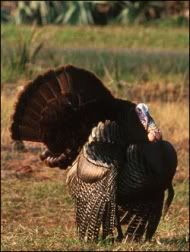
The Florida wild turkey is smaller and darker in color than the eastern wild turkey and also has less white veining in the wing quills. The white bars in the primary feathers are narrow, irregular, broken and do not extend all the way to the feather shaft, while secondary wing feathers are a darker brown. The pattern does not form triangular patches as does the Eastern’s feathers. The dark colors of the tail coverts (smaller feathers at the base of the tail) and the brown-tipped large tail feathers resemble those of the Eastern.
Average Weight Range
Adult Florida wild turkeys weigh six to over 16 pounds.
Reproduction
The breeding cycle for the Florida wild is slightly earlier than the eastern wild, usually in February. However, turkeys can start gobbling as early as January in southern parts of Florida. Egg laying starts in April, and hatching usually occurs in May. Males exhibit both gobbling and strutting to attract females. Gobbling attracts the hen to the male, who then courts the female by strutting. If the gobbler is successful, the female will crouch to signal the male to begin copulation. The first peak time for gobbling occurs at the beginning of breeding season when gobblers are searching for hens. The second peak begins a few weeks later, when most hens begin incubation. Gobblers usually mate with several hens, and it is generally the adult males who do most of the mating. Hens lay anywhere from 10 to 12 eggs per clutch, averaging about 28 days for incubation.
Food Usage/Selection
Wild turkeys are omnivores, eating a variety of plant and animal matter wherever and whenever available. Poults, or young turkey, eat large quantities of insects and other animal matter to get the needed protein for rapid development. As turkeys age, plant matter becomes the primary food source with about 90 percent of the mature turkey’s diet including the green foliage of grasses, vines, forbs, acorns, buds, seeds and various fruits.
Range
The Florida bird is indigenous to the Florida peninsula.
Habitat
The Florida turkey inhabits the Florida swamplands and prefers a moist, marshy environment.
Common Hunting Methods
The shotgun, bow and arrow, and black powder are all used to hunt turkey. To attract turkeys, hunters use a wide range of calls to the turkey or to induce gobblers to fight. Calling has become so popular that contests are held each year so experts and novices alike can fine-tune their skills.
Hunting Challenges/Values
With their excellent eyesight and well-developed sense of hearing, the turkey can sometimes outsmart decoys used by hunters as they become more and more sensitized to their presence. Wild turkeys are very good to eat and can be smoked, fried or baked. Many hunters proudly display their colorful capes, beards or full-bodied mounts.
Interesting Tidbits
Turkeys will answer thunder from an approaching storm with calls of their own.
Hens produce droppings in shapes like a mound, and the gobbler’s droppings are in a straight line or resemble the letter “J.”
Named for the famous Seminole Chief Osceola, who led a war against Americans in 1835.
Read about other Turkey subspecies:
Eastern Wild Turkey
Gould's Turkey
Merriam's Turkey
Ocellated Turkey
Osceola/Florida Turkey
Rio Grande Turkey
Tuesday, July 04, 2006
Ocellated Turkey (Meleagris ocellata)
 Physical Description
The ocellated species is easily distinguished from the other North American subspecies primarily because its legs are shorter and thinner than other species. Tail feathers are bluish gray with a well-defined eye-shaped blue bronze colored spot near the end followed by a bright gold tip. The name is derived from the resemblance of the tail feathers’ spots to an eye (oculus). Both sexes have a blue colored head and neck with distinctive orange-to-red, warty, carnucle-like growths called nodules. These growths are more prominent on gobblers. The head of the male also has a fleshy blue crown behind the snood, which has nodules similar to those on the neck. The bird also has a distinct eye ring of bright red colored skin especially visible on the tom during breeding season. Neither toms nor hens of this species have beards, and breast feathers do not differ between males and females.
Average Weight Range
Adult ocellated turkeys weigh from six to 12 pounds.
Reproduction
Breeding occurs during the spring and summer months (May through August). The increase of daylight hours in spring triggers hormonal changes. Gobbling is used to attract receptive females for mating in late February to early March. Males exhibit both gobbling and strutting to attract females. Gobbling attracts the hen to the male, who then courts the female by strutting. If the gobbler is successful, the female will crouch to signal the male to begin copulation. The first peak time for gobbling occurs at the beginning of breeding season when gobblers are searching for hens. The second peak begins a few weeks later, when most hens begin incubation. Gobblers usually mate with several hens, and it is generally the adult males who do most of the mating. Hens lay anywhere from 8 to 12 eggs per clutch, averaging about 28 days for incubation.
Food Usage/Selection
Wild turkeys are omnivores, eating a variety of plant and animal matter wherever and whenever available. Poults, or young turkey, eat large quantities of insects and other animal matter to get needed protein for development. As turkeys age, plant matter becomes the primary food source with about 90 percent of the mature turkey’s diet including the green foliage of grasses, vines, forbs, acorns, buds, seeds and various fruits.
Range
The Ocellated turkey inhabits Central America and parts of Mexico’s Yucatan Peninsula.
Habitat
The ocellated turkey exists only in a 50,000 square mile area in the Yucatan peninsula range in southeastern Mexico including the states of Quintana Roo, Compeche, Peten, and Yucatan, also, southern Tabasco and northeastern Chiapas. It prefers brushy areas near streams and rivers or mesquite, pine, and scrub forests
Common Hunting Methods
The shotgun, bow and arrow, and black powder are all used to hunt turkey. To attract turkeys, hunters use a wide range of turkey calls to lure the turkey or to induce gobblers to a fight. Calling has become so popular that contests are held each year so experts and novices alike can fine-tune their skills.
Hunting Challenges/Values
With their excellent eyesight and well-developed sense of hearing, the turkey can sometimes outsmart decoys used by hunters as they become more and more sensitized to their presence. Wild turkeys are very good to eat and can be smoked, fried or baked. Many hunters proudly display their colorful capes, beards or full-bodied mounts.
Interesting Tidbits
Turkeys will answer thunder from an approaching storm with calls of their own.
Turkey hunting is one of the most popular forms of hunting.
Hens produce droppings in shapes like a mound, and the gobbler’s droppings are in a straight line or resemble the letter “J.”
It is also known by these names, depending on its Central America location: pavo, pavo ocelado, or the Mayan Indian ucutz il chican.
Read about other Turkey subspecies:
Eastern Wild Turkey
Gould's Turkey
Merriam's Turkey
Ocellated Turkey
Osceola/Florida Turkey
Rio Grande Turkey
Merriam's Turkey (Meleagris gallopavo merriami)
 Physical Description
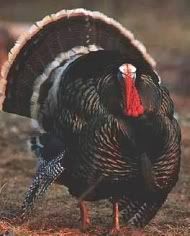
Although approximately the same size as the Eastern, the Merriam has different coloration. It is black with blue, purple and bronze reflections. White feathers on the lower back and tail feather margins distinguish the Merriam from other subspecies of turkey. The margins have a dull white appearance. Merriam’s appear to have a white rump due to pinkish buff, or whitish tail coverts and tips. The tail feathers are very conspicuous when the gobbler struts against a dark background. Toms have black-tipped breast feathers, while the hens exhibit buff tips. Hens have a more extensive white area on the wings giving a whiter appearance when the wings are folded.
Average Weight Range
Mature Merriam wild turkeys weigh from eight to over 20 pounds.
Reproduction
Breeding occurs during the spring and summer months (May through August). The increase of daylight hours in spring triggers hormonal changes. Gobbling is used to attract receptive females for mating in late February to early March. Males exhibit both gobbling and strutting to attract females. Gobbling attracts the hen to the male, who then courts the female by strutting. If the gobbler is successful, the female will crouch to signal the male to begin copulation. The first peak time for gobbling occurs at the beginning of breeding season when gobblers are searching for hens. The second peak begins a few weeks later, when most hens begin incubation. Gobblers mate with several hens, and it is generally the adult males who do most of the mating. Hens lay anywhere from 8 to 12 eggs per clutch, averaging about 28 days for incubation.
Food Usage/Selection
Wild turkeys are omnivores, eating a variety of plant and animal matter wherever and whenever available. Poults, or young turkey, eat large quantities of insects and other animal matter to get needed protein for development. As turkeys age, plant matter becomes the primary food source with about 90 percent of the mature turkey’s diet including the green foliage of grasses, vines, forbs, acorns, buds, seeds and various fruits.
Range
The Merriam is found in the ponderosa pine forests of Arizona, New Mexico, Colorado, and the rest of the Rocky Mountain range, and has been transplanted to Nebraska, Washington, California, Oregon, and the Canadian provinces of Alberta and Manitoba.
Habitat
Merriam’s wild turkeys inhabit ponderosa pine forests, western mountainous regions of the United States and the woodland prairies. Merriam’s tend to live in regions that receive annual rainfall of 15 to 23 inches.
Common Hunting Methods
The shotgun, bow and arrow, and black powder are all used to hunt turkey. To attract turkey, hunters use a wide range of calls to lure them or to induce gobblers to a fight. Calling has become so popular that contests are held each year so experts and novices alike can fine-tune their skills.
Hunting Challenges/Values
With their excellent eyesight and well-developed sense of hearing, the turkey can sometimes outsmart decoys used by hunters as they become more and more sensitized to their presence. Wild turkeys are very good to eat and can be smoked, fried or baked. Many hunters proudly display their colorful capes, beards or full-bodied mounts.
Interesting Tidbits
Turkeys will answer thunder from an approaching storm with calls of their own.
Turkey hunting is one of the most popular forms of hunting.
Hens produce droppings in shapes like a mound, and the gobbler’s droppings are in a straight line or resemble the letter “J.”
Named for C. Hart Merriam, who was the first chief of the U. S. Biological Survey.
Read about other Turkey subspecies:
Eastern Wild Turkey
Gould's Turkey
Merriam's Turkey
Ocellated Turkey
Osceola/Florida Turkey
Rio Grande Turkey
Gould's Turkey (Meleagris gallopavo mexicana)
 Physical Description
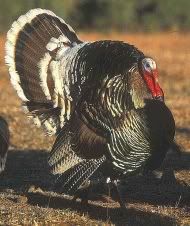
Gould’s Turkey is the largest of the five North American subspecies. It also has longer legs, larger feet, and larger center tail feathers than other wild turkey. White tips on the tail feathers and tail coverts, which usually separate to exhibit an “eyelash” appearance, distinguish Gould’s from other turkeys. The body plumage is blue-green in color and the lower back and rump feathers have copper and greenish-golden reflections unlike the faintly iridescent velvety black of the Merriam’s. Hens have a less pronounced metallic green and red sheen and are more purplish in color.
Average Weight Range
Mature Gould’s wild turkeys weigh eight to over 25 pounds.
Reproduction
Gobbling activity for the Gould’s occurs from April to June in association with plant growth in its habitat. The increase of daylight hours in also spring triggers hormonal changes. Males exhibit both gobbling and strutting to attract females. Gobbling attracts the hen to the male, who then courts the female by strutting. If the gobbler is successful, the female will crouch to signal the male to begin copulation. The first peak time for gobbling occurs at the beginning of breeding season when gobblers are searching for hens. The second peak begins a few weeks later, when most hens begin incubation. Gobblers usually mate with several hens, and it is generally the adult males who do most of the mating. Hens lay anywhere from 8 to 12 eggs per clutch, averaging about 28 days for incubation.
Food Usage/Selection
Wild turkeys are omnivores, eating a variety of plant and animal matter wherever and whenever available. Poults, or young turkey, eat large quantities of insects and other animal matter to get needed protein for development. As turkeys age, plant matter becomes the primary food source with 90 percent of the mature turkey’s diet including the green foliage of grasses, vines, forbs, acorns, buds, seeds and various fruits.
Range
Gould’s can be found in small numbers in Arizona and New Mexico but is abundant in northwestern regions of Mexico. They inhabit mountainous terrain found in the Sierra Madre Occidental Mountains of Mexico, the Animas and San Luis Mountains of New Mexico and in the Peloncillo Mountains of New Mexico and Arizona.
Habitat
Gould’s utilize areas of underbrush, along creek beds or other areas of thick brush with scattered openings in mountainous regions.
Common Hunting Methods
The shotgun, bow and arrow, and black powder are all used to hunt turkey. To attract turkeys, hunters use a wide range of turkey calls to lure the turkey or to induce gobblers to a fight. Calling has become so popular that contests are held each year so experts and novices alike can fine-tune their skills.
Hunting Challenges/Values
With their excellent eyesight and well-developed sense of hearing, the turkey can sometimes outsmart decoys used by hunters as they become more and more sensitized to their presence. Wild turkeys are very good to eat and can be smoked, fried or baked. Many hunters proudly display their colorful capes, beards or full-bodied mounts.
Interesting Tidbits
Turkeys will answer thunder from an approaching storm with calls of their own.
Turkey hunting is one of the most popular forms of hunting.
Hens produce droppings in shapes like a mound, and the gobbler’s droppings are in a straight line or resemble the letter “J.”
They are the least known of the turkey subspecies, first described by J. Gould during his travels in Mexico.
Read about other Turkey subspecies:
Eastern Wild Turkey
Gould's Turkey
Merriam's Turkey
Ocellated Turkey
Osceola/Florida Turkey
Rio Grande Turkey
Eastern Turkey (Meleagris gallopavo silvestris)
 Physical Description
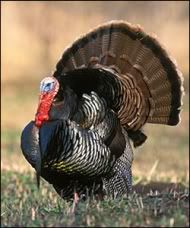
Chestnut brown-tipped tail coverts (smaller feathers which cover up larger ones) and dark-buff or chocolate-brown tail tips characterize the most abundant and most widely hunted turkey, the Eastern Wild Turkey. The tom turkey’s breast feathers are tipped in black, while other body feathers are colored with copper or bronze metallic iridescence. The primary wing feathers have white and black bars that extend to the feather shaft, while the secondary wing feathers mainly have prominent white bars. This results in a white triangular area on each side of the back when the wings are folded backward. Hens are browner with less brilliant iridescence and the breast feathers are tipped in buff or chestnut. The Eastern tom and hen generally can grow up to four feet in height.
Average Weight Range
The mature Eastern Wild Turkey weighs from eight to 25 pounds, with some individual toms topping 30 pounds.
Reproduction
Breeding occurs during the spring and summer months, usually starting in late February or early March in southern states. Breeding won’t occur until April in northern states such as Vermont and other northernmost areas. The cycle is complete with the hatching of poults in summer. The increase of daylight hours in spring triggers hormonal changes. Males exhibit both gobbling and strutting to attract females. Gobbling attracts the hen to the male with specific mating calls. The male will then court the female by strutting back and forth. If the gobbler is successful, the female will crouch to signal the male to begin copulation. The first peak time for gobbling occurs at the beginning of breeding season when gobblers are searching for hens. The second peak begins a few weeks later, when most hens begin incubation. Gobblers usually mate with several hens, and it is generally the adult males who do most of the mating. Hens lay anywhere from 8 to 12 eggs per clutch, averaging about 28 days for incubation.
Food Usage/Selection
Wild turkeys are omnivores, eating a variety of plant and animal matter wherever and whenever available. Poults eat large quantities of insects and other animal matter to get needed protein for development. As turkeys age, plant matter becomes the primary food source. About 90 percent of the mature turkey’s diet comes from plants, including green foliage of grasses, vines, forbs, acorns, buds, seeds, various fruits and waste grain from agricultural crops.
Range
The Eastern Wild Turkey inhabits the eastern half of the U.S., and can be found in hardwood and mixed forests from New England and southern Canada to northern Florida and west to Texas, Missouri, Kansas, Iowa, and Minnesota, however, it has been transplanted in California, Oregon, and Washington and other areas west of the Rocky Mountains.
Habitat
The Eastern turkey, which has adapted to many habitats, utilizes both hardwood and softwood forests, open pastures, and agricultural fields.
Common Hunting Methods
The shotgun, bow and arrow, and black powder are all used to hunt turkey. Rifles are also allowed in some states. Hunters use a wide variety of calls to attract turkeys within shooting range. Calling has become so popular that contests are held each year so experts and novices alike can fine-tune their skills.
Hunting Challenges/Values
With their excellent eyesight and well-developed sense of hearing, turkeys are constantly aware of their surroundings. The turkey can sometimes outsmart hunters who use decoys as they become more and more sensitized to their presence. Wild turkeys are very good to eat and can be smoked, fried or baked. Many hunters proudly display their colorful capes, beards or full-bodied mounts.
Interesting Tidbits
Turkeys will answer thunder from an approaching storm with a shock gobble.
Turkey hunting is one of the most popular forms of hunting.
Hens produce droppings in shapes like a mound, and the gobbler’s droppings are in a straight line or resemble the letter “J.”
Read about other Turkey subspecies:
Eastern Wild Turkey
Gould's Turkey
Merriam's Turkey
Ocellated Turkey
Osceola/Florida Turkey
Rio Grande Turkey
Subscribe to:
Posts (Atom)
