CHANNEL ISLANDS -- An animal rights group has sued the National Park Service and The Nature Conservancy in an attempt to stop the eradication of wild turkeys on Santa Cruz Island off the Central California coast.
The suit alleges the defendants have hired an Australian company called ProHunt to eradicate the turkeys in an attempt to protect the island's natural habitat.
Wild turkeys were introduced to the island off Santa Barbara in 1972 by a rancher.
Scientists have said the kills are necessary because turkeys provide prey for golden eagles, who also kill the island's endangered foxes.
A spokeswoman for the National Park Service says no wild turkeys had been killed on federal land. She said she could not comment on the lawsuit because she has not seen it.
Source: kcoy.com

Thursday, January 25, 2007


Wednesday, January 17, 2007
How to Score Your Wild Turkey Trophy
 Ever wondered how to measure your trophy tom?
Before you begin to score your turkey, be sure to note that all measurements are taken in 1/16-inch increments and converted to decimal form. A current NWTF member or another licensed hunter from the U.S State or Canadian Province where the bird was harvested must verify all measurements. The National Wild Turkey Federation is the official record keeper of all trophy turkeys entered into the record books.
The National Wild Turkey Federation has an easy step-by-step trophy measuring guide and an online measurement scoring calculator.
NWTF Trophy Scoring Guide and Score Calculator
Saturday, January 13, 2007
Top Turkey Callers Flock to Nashville
 NASHVILLE, Tenn. - Whether cutting, yelping, gobbling or hooting, Wild Turkey Bourbon/National Wild Turkey Federation Grand National Calling contestants feel the pressure during the "Super Bowl" of turkey calling.
The championships will draw the best turkey callers from across North America to compete at the Gaylord Opryland Resort and Convention Center in Nashville, Tenn., February 22 to Feb. 25, during the NWTF's 31st annual National Convention and Sport Show.
The 31st annual Convention and Sport Show calling contest schedule of events:
Thursday, February 22, 2007
- Wild Turkey Bourbon/NWTF Grand National Friction Calling Contest
- Wild Turkey Bourbon/NWTF Grand National Senior Division Preliminaries
- NWTF Grand National Intermediate Calling Championships
- Wild Turkey Bourbon/NWTF Grand National Spit, Drum and Gobbling Show
- NWTF Grand National Junior Calling Championships
- Wild Turkey Bourbon/NWTF Grand National Gobbling Championships
- Wild Turkey Bourbon/NWTF Grand National Owl Hooting Championships
- Wild Turkey Bourbon/NWTF Grand National Senior Division Finals
- Wild Turkey Bourbon/NWTF Grand National Team Challenge Championships
- Wild Turkey Bourbon/NWTF Grand National Rare Breed Champion of Champions Competition
For more information about the NWTF's 31st annual Convention and Sport Show, or the Wild Turkey Bourbon/NWTF Grand National Calling Championships call (800) THE-NWTF.
Monday, January 08, 2007
Benelli Super Nova Shotgun
For me the deer-hunting season has come to a close. (If it hasn’t for you then you had better rush over to Whitetail Deer Passion and read my article “Last Chance”, where I outline tips and tricks for late season whitetail deer hunters.) For the hunters, like myself, who now begin to think of the upcoming spring turkey season, please read on.

 For some weeks now I have been thinking about purchasing a new shotgun. In the course of these weeks I have read many field tests and opinions of other hunters on the subject and have now narrowed my research down to the Super Nova from the Italian gun makers Benelli.
When I look to purchase a new product it has to fulfill a few criteria and being all the new hype is not one of them. First and foremost the product has to be safe to use, followed by quality / price relation. The gun I am looking for has to keep up with my style of hunting. I don’t like to be “careful” because the product might fall apart when I accidentally knock it against a tree or rock. Preferably the product should serve several purposes; I never saw much sense in purchasing different guns for different hunting styles. The gun should be reliable without to many gizmos and fancy attachments that are bound to fail me in the field. And finally the gun has to stand up to different weather conditions without having to completely take it apart in order to dry it out after a heavy rain.
For me the gun that has thus far measured up to my expectations seems to be the Benelli Super Nova. I say “thus far” because the final and deciding moment will come when I visit a friend in the next few days that owns a Benelli Super Nova. He kindly offered me to take his gun to the range and put it through its paces. Once I spent a day pumping different loads and shell sizes through it I will decide to give it the thumbs up or down.
For now I leave you with some of the Benelli Super Nova’s specs that in my opinion make it my kind of shotgun.
I am partial to pump action shotguns. What I like about that type of action is the simple rugged reliability plus the fast and worry free handling but that alone does not make the Super Nova my choice. Here is what does:
The Super Nova is made by the Italian company Benelli. One can say what one likes, but the Italians know how to build good solid quality shotguns at an affordable price. And that is exactly where the Super Nova shines bright. The Super Nova is well built with the customarily good workmanship common to most Italian guns and has a lot of good and new ideas added to it.
I read of a duck and dove hunt outfitter down in Mississippi that uses 20 Super Nova guns as loan guns for his clients. He claims that on average they shoot up to 10’000 rounds in one hunting season with these guns and never had a gun yet that failed them or gave then any trouble whatsoever. Anybody that went on a dove hunt knows that the shooting can be fast and furious and adding to this is the fact that these guns are shot by many different people - so you get an idea as to what the Super Nova’s have to stand up too.
That’s it so far and like I said before, sometime next week I will be able to actually shoot the Super Nova. After this final deciding test I will make my mind up if this is the gun for me. Stay tuned here, as I will let you know how the Super Nova behaved and handled at the shooting range.
Tags: Shotgun, Benelli Super Nova, Turkey Hunting
For some weeks now I have been thinking about purchasing a new shotgun. In the course of these weeks I have read many field tests and opinions of other hunters on the subject and have now narrowed my research down to the Super Nova from the Italian gun makers Benelli.When I look to purchase a new product it has to fulfill a few criteria and being all the new hype is not one of them. First and foremost the product has to be safe to use, followed by quality / price relation. The gun I am looking for has to keep up with my style of hunting. I don’t like to be “careful” because the product might fall apart when I accidentally knock it against a tree or rock. Preferably the product should serve several purposes; I never saw much sense in purchasing different guns for different hunting styles. The gun should be reliable without to many gizmos and fancy attachments that are bound to fail me in the field. And finally the gun has to stand up to different weather conditions without having to completely take it apart in order to dry it out after a heavy rain.
For me the gun that has thus far measured up to my expectations seems to be the Benelli Super Nova. I say “thus far” because the final and deciding moment will come when I visit a friend in the next few days that owns a Benelli Super Nova. He kindly offered me to take his gun to the range and put it through its paces. Once I spent a day pumping different loads and shell sizes through it I will decide to give it the thumbs up or down.
For now I leave you with some of the Benelli Super Nova’s specs that in my opinion make it my kind of shotgun.
I am partial to pump action shotguns. What I like about that type of action is the simple rugged reliability plus the fast and worry free handling but that alone does not make the Super Nova my choice. Here is what does:
The Super Nova is made by the Italian company Benelli. One can say what one likes, but the Italians know how to build good solid quality shotguns at an affordable price. And that is exactly where the Super Nova shines bright. The Super Nova is well built with the customarily good workmanship common to most Italian guns and has a lot of good and new ideas added to it.
- The Super Nova is chambered for 12 gauge 3 ½-inch shells and also can be loaded with 2-3/4-inch and 3-inch loads making it a truly “load all” gun.
- A newly designed synthetic “Steady Gripä” and ComforTechä Polymer molded stock makes this gun almost waterproof and in addition reduces the heavy recoil associated with magnum shotguns up to 45%, making it a moderate recoil gun.
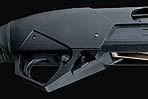 The gun comes in two finishes: matte black or camouflage. The SuperNova’s newly styled trigger guard, similar to the Super Black Eagle II, allows for 30% more finger room for a gloved hand. In addition, a new, larger safety button provides easy acquisition and quick, positive function.
- The nicely ribbed barrel of the Nova is finished in a dull black color that matches the black polymer of the stocks and receiver perfectly. Barrels are available in 24", 26" and 28" lengths complete with three screw-in choke tubes, and a 18.5" rifled slug barrel is available with open sights. This makes the Super Nova one of the most versatile shotguns on the market today.
- And finally, with a price tag of $380.00 to $410.00 this is a very affordable gun built to a high quality standard.
I read of a duck and dove hunt outfitter down in Mississippi that uses 20 Super Nova guns as loan guns for his clients. He claims that on average they shoot up to 10’000 rounds in one hunting season with these guns and never had a gun yet that failed them or gave then any trouble whatsoever. Anybody that went on a dove hunt knows that the shooting can be fast and furious and adding to this is the fact that these guns are shot by many different people - so you get an idea as to what the Super Nova’s have to stand up too.
That’s it so far and like I said before, sometime next week I will be able to actually shoot the Super Nova. After this final deciding test I will make my mind up if this is the gun for me. Stay tuned here, as I will let you know how the Super Nova behaved and handled at the shooting range.
Tags: Shotgun, Benelli Super Nova, Turkey Hunting
Saturday, January 06, 2007
Murrey Honored for More Than 30 Years of Conserving the Wild Turkey
 NWTF Board of Directors member Sam Mars, left, presents Jack Murrey with the Joe Kurz Award recently. Photo courtesy of the Tennessee Wildlife Resources Agency
NASHVILLE, Tenn. - For more than 30 years, John "Jack" Murrey of Nashville, has dedicated his life to wild turkeys and the Tennessee Wildlife Resources Agency (TWRA). As the turkey program coordinator, Murrey has been instrumental in restocking more than 10,000 wild turkeys and returning the thunderous gobble of the wild turkey for Tennessee's outdoor enthusiasts.
To honor Murrey for his dedication, the National Wild Turkey Federation (NWTF) recently awarded him the 2007 Joe Kurz Excellence in Wildlife Management Award during a special ceremony in honor of Murrey.
The Joe Kurz award recognizes wildlife managers who have worked tirelessly for the wild turkey and its habitat. Managers, such as Murrey, are the unsung heroes who do the on-the-ground work for wild turkeys and other wildlife.
"If you hunt wild turkeys in Tennessee, Jack Murrey deserves your gratitude for bringing the wild turkey back," said Dr. James Earl Kennamer, NWTF senior vice president for conservation programs. "Murrey's dedication to the wild turkey is an example of why Tennessee enjoys great turkey hunting and will continue to do so in the future."
During his tenure as TWRA turkey program coordinator, Murrey worked to gain the support of TWRA law enforcement and administrative staff to expand turkey populations throughout Tennessee. Murrey was a member of the NWTF's Technical Committee between 1976 until his retirement in 2003. He continues to play a vital role in the wild turkey program for the Volunteer State as a member of his local NWTF chapter.
Source: NWTF Press Release
Tuesday, January 02, 2007
Technology Tells Researchers Where Wild Turkeys Roam
NWTF Press Release
Biologists in Minnesota will soon have a better understanding of wild turkeys and their movements in Northern regions because of National Wild Turkey Federation contributions to research totaling more than $10,000.
The NWTF's Minnesota State Chapter and the Minnesota Department of Natural Resources each recently contributed $5,200 for a University of North Dakota research project to better understand wild turkey movements through different habitats.
Last year, the state chapter donated $5,000 to the project when 80 wild turkeys were released in Red Lake Falls and Thief River Falls, the sites of Minnesota's northernmost wild turkey releases. Fifty-nine of the turkeys were equipped with radio transmitters. This year, the NWTF and MDNR each purchased four Global Positioning System (GPS) transmitters that record turkey movements more accurately than the old-fashioned radio transmitters.
"In the past, researchers had to go to the field to record the locations of the birds," said Dave Neu, NWTF regional biologist in Minnesota. "That method only allowed records to be taken about four times per week. These units receive a GPS signal from satellites that is recorded 48 times daily. The unit falls off the turkey after a few months and is located by researchers with all of the data stored and ready to use."
The data collected will allow biologists to make better-informed decisions about transplanting and managing wild turkey populations in northern regions and will be complete in March of 2007.
During the past 25 years, Minnesota's wild turkey population has grown from a few birds to more than 30,000 across the state. Last year, hunters in Minnesota harvested more than 5,000 wild turkeys during the spring season.
"These projects are important to NWTF members because they help MDNR biologists make sound decisions on the state's wild turkey population," said Neu. "Minnesota's NWTF chapters have worked to improve turkey populations since 1976 by helping fund the MDNR's turkey trapping program, and our volunteers want to do all they can to continue improving wild turkey populations throughout the state."
Source: National Wild Turkey Federation
Biologists in Minnesota will soon have a better understanding of wild turkeys and their movements in Northern regions because of National Wild Turkey Federation contributions to research totaling more than $10,000.
The NWTF's Minnesota State Chapter and the Minnesota Department of Natural Resources each recently contributed $5,200 for a University of North Dakota research project to better understand wild turkey movements through different habitats.
Last year, the state chapter donated $5,000 to the project when 80 wild turkeys were released in Red Lake Falls and Thief River Falls, the sites of Minnesota's northernmost wild turkey releases. Fifty-nine of the turkeys were equipped with radio transmitters. This year, the NWTF and MDNR each purchased four Global Positioning System (GPS) transmitters that record turkey movements more accurately than the old-fashioned radio transmitters.
"In the past, researchers had to go to the field to record the locations of the birds," said Dave Neu, NWTF regional biologist in Minnesota. "That method only allowed records to be taken about four times per week. These units receive a GPS signal from satellites that is recorded 48 times daily. The unit falls off the turkey after a few months and is located by researchers with all of the data stored and ready to use."
The data collected will allow biologists to make better-informed decisions about transplanting and managing wild turkey populations in northern regions and will be complete in March of 2007.
During the past 25 years, Minnesota's wild turkey population has grown from a few birds to more than 30,000 across the state. Last year, hunters in Minnesota harvested more than 5,000 wild turkeys during the spring season.
"These projects are important to NWTF members because they help MDNR biologists make sound decisions on the state's wild turkey population," said Neu. "Minnesota's NWTF chapters have worked to improve turkey populations since 1976 by helping fund the MDNR's turkey trapping program, and our volunteers want to do all they can to continue improving wild turkey populations throughout the state."
Source: National Wild Turkey Federation
Monday, January 01, 2007
Turkey Hunting Equipment
Turkey hunting's popularity today has given rise to a vast assortment of equipment and different hunting methods. The restoration of the wild turkey population in North America is one of the most successful wildlife management successes in our history. From near extinction in the early 1900’s, the species now numbers in the millions and can be found in every American state except Alaska and in every Canadian Province except the Northern Territories. Both the population and the range are expected to continue growing.
The success of the wild turkey restoration has given the enthusiastic hunter the opportunity to pursue the wild turkey using different methods. Many U.S. states and Canadian provinces offer a spring turkey hunting season and a fall turkey hunting season with special segments for bows, shotguns, centrefire rifles and even muzzleloaders. Following I will discuss with you the different methods by which turkeys can be hunted and the special requirements needed for the different segments.
Shotguns
…loaded with birdshot are by far the most popular tools of choice of the turkey hunters and accounts for more than 90% of all turkeys taken. Of these the pump action shotguns are more poplar than others, such as the double barrel shotgun or the semi-automatics. A pump action is relatively light and allows the hunter quick follow-up shots if needed. The preferred caliber is a 12 gauge chambered for 3” to 3 ½ ”. A good turkey gun should have a barrel of no less than 22”, with a 24” to 26” barrel being a better choice. A longer barrel usually gives a little better performance and velocity of the shot pellets.
Fixed-choke barrels should have a full choke to provide the tight pattern needed for killing headshots on turkeys. Barrels with interchangeable choke tubes can be fitted with “full”, “extra full” or “special turkey” choke tubes. Exactly what choke tube is best will have to be decided at the shooting range. Not every gun delivers the best accuracy with the same type of choke tube. While one gun performs better with a full choke another may do better with an extra full choke. Only time spent on the shooting range and shooting different loads with different choke tubes and shot sizes will determine what your gun likes best. A word of caution: the extra tight “turkey” choke tube delivers a very tight pattern intended for use with lead shot only; shooting steel shot can easily damage the choke or barrel. These extra tight choke tubes also deliver hefty recoil as the pellets are condensed and forced trough the tight muzzle of the gun. This is especially true for some of the super magnum “turkey special” shells available today.
A turkey is a very though bird to kill and keep on the ground, ad to this the relatively small size of the target – the turkeys head - and even a novice hunter will realize how important proper patterning of your gun is. A well-patterned gun will deliver a dense pattern out to about 30 to 40 yards that will place consistently 8 to 12 pellets into turkeys’ head and neck. The most common shot size choices are #4, #5, or #6 shot pushed by a large powder charge. Buffered loads of nickel or copper plated shot pattern best because the buffering reduce “flyers”, deformed pellets that fly of course.
Muzzleloaders
Over the past decade turkey hunters looking for a special challenge to an already demanding sport turned to muzzleloading shotguns. Until recently, these weren’t exactly ideal for turkey hunting. The cylinder-bore barrels common to most muzzleloader shotguns simply could not produce the tight patterns needed to be an effective turkey-killing tool. However, today this has changed. The newer generation of muzzleloader shotguns caters to the new found enthusiasm of muzzleloader turkey hunting by offering either fixed full-choke barrels or interchangeable choke systems.
Even so, in effective range and firepower the muzzleloader is no match to a modern “turkey special” 12-gauge pump action gun. Nevertheless a growing number of hunters seem to accept the limitations of a muzzleloader in exchange of the satisfaction of a traditional means of taking a turkey and using better woodsmanship to get closer to the birds than is necessary with a modern day shotgun.
Among muzzloader turkey hunters the 12 gauge caplock double barrel is the favorite tool to take on a turkey hunt. The double barrel allows for a quick follow-up shot if needed but require special safety requirements. After firing one barrel always remove the percussion cap from the nipple of the loaded barrel before reloading the empty barrel. Also get into the habit of tamping down the load in the loaded barrel as the recoil may have created a space between powder charge and shot. To make sure you do not load the same barrel twice cut a little notch into the ramrod at the muzzle when the rod rests on the full charge, this will be your “barrel charged” indicator, if the mark is in line with muzzle the barrel is charged, does the mark fall below the muzzle the barrel is empty.
To build a turkey-hunting load you need five components: powder, shot, over-shot wads and percussion caps. Before you begin loading your muzzleloader shotgun read and study the manufactures owner manual, where you also will find loading tables for your particular muzzleloader. Caution: Never use a heavier load than is recommended by the gun manufacturer as the upper limit. Pyrodex RS or blackpowder in either FFg or Fg granulation may be used in modern muzzleloader shotguns.
Some hunters assume that the maximum allowed powder load gives the best performance, but like with most things in life and hunting, more is seldom better. The same rules as with a regular shotgun apply to a muzzleloader shotgun, the only way to determine the load that will give you the best performance is to spend many hours at the range. Working up a perfect load for your blackpowder gun is tedious work where attention to detail is paramount to achieving accuracy. In muzzleloading each load is truly a custom load, hours are spent on the range trying out and mixing different components that make up a load until one arrives at the perfect compromise of sufficient power, range and shot pattern. As you work up a load keep a notebook and a loading table handy for reference and to make notes. If you are a newcomer to muzzleloader hunting I strongly suggest that you read as much information about muzzleloader hunting as possible and in addition purchase a few of the many good books on the subject.
Rifles
Where permitted to hunt turkeys with rifles as well as shotguns, rifles account for more kills than shotguns. Hunting turkeys with a rifle requires good marksmanship to make the often long-range head shots. A turkey hit in the body with your favorite deer rifle, is often rendered both dead and inedible at the impact of the bullet. Serious rifle turkey hunters prefer accurate rifles chambered for smaller calibers, such as the .22-250 Rem. And .223 Rem. With the choice of many high quality loads on the market for these calibers achieving a high degree of accuracy is not impossible. The avid rifle turkey hunter carefully hand-loads that maintain excellent accuracy at ranges under 200 yards, while reducing velocity to levels that minimize meat damage.
At ranges under 100 yards the little .17 Remington has acquired a large following among rifle turkey hunters. The small 25-grain bullet kills a turkey instantly with little meat damage. Another favorite is the good old .22 Winchester Rimfire Magnum. A riflescope in the range of 3-9x40 or 4.5-12 will bring the target very close and aid in the accuracy of the shot placement.
Archery
Trying to kill a turkey with archery equipment is at best a very challenging and though job. Calling a turkey nervous and wide-eyed within the effective range of 15 to 20 yards needed for a killing shot with bow and arrow requires exceptional calling expertise, patience and camouflage skills. Bringing the turkey close to you in one thing but then having to put the calls down, pick up the bow and draw the string is quite another story.
For the bow turkey hunter the compound bow is the best choice. Because of the substantial time laps between drawing and releasing the string other bows are less favorable. The compound permits you to hold the string drawn fro some time without fatigue. Where legal, a crossbow is the best choice of archery equipment for turkey hunting as you can preload the arrow and keep the string drawn without holding it.
If legal in your area use a natural or commercial groundblind to disguise your movement of drawing the bowstring back. Decoys are good too to take a toms attention away from you. Caution: do not use decoys on public land or anywhere where you share the land with other hunters, it just is too dangerous.
Because an archer needs both hands to shoot a bow, most bowhunters use mouth calls to lure the turkey the last few yards closer to the hunter. If you can not use a groundblind and, or a crossbow it is a good tactic to sit absolutely still and wait until the turkey turn around strutting showing you his “bulls-eye”, the fanned tail will obstruct his view to the back. Now, pick up your bow, draw the string aim for the bulls-eye and let the arrow fly.
The average deer-hunting bow is more than sufficient to kill a turkey. Set the draw weight lower, around 30 lbs. to 45 lbs are plenty good, this will help you to hold the string back for a considerable without beginning to shake from fatigue. The arrows should be tipped with a large cutting diameter broadhead and some sort of “grabbers” to prevent a complete pass trough shot. It is nearly impossible to retrieve a bird after a pass trough shot as he will take off and fly away even if mortally wounded. If the arrow stays in the bird it will prevent him form taking off flying. Good quality expandable broadheads are excellent turkey killers.
The success of the wild turkey restoration has given the enthusiastic hunter the opportunity to pursue the wild turkey using different methods. Many U.S. states and Canadian provinces offer a spring turkey hunting season and a fall turkey hunting season with special segments for bows, shotguns, centrefire rifles and even muzzleloaders. Following I will discuss with you the different methods by which turkeys can be hunted and the special requirements needed for the different segments.
Shotguns
…loaded with birdshot are by far the most popular tools of choice of the turkey hunters and accounts for more than 90% of all turkeys taken. Of these the pump action shotguns are more poplar than others, such as the double barrel shotgun or the semi-automatics. A pump action is relatively light and allows the hunter quick follow-up shots if needed. The preferred caliber is a 12 gauge chambered for 3” to 3 ½ ”. A good turkey gun should have a barrel of no less than 22”, with a 24” to 26” barrel being a better choice. A longer barrel usually gives a little better performance and velocity of the shot pellets.
Fixed-choke barrels should have a full choke to provide the tight pattern needed for killing headshots on turkeys. Barrels with interchangeable choke tubes can be fitted with “full”, “extra full” or “special turkey” choke tubes. Exactly what choke tube is best will have to be decided at the shooting range. Not every gun delivers the best accuracy with the same type of choke tube. While one gun performs better with a full choke another may do better with an extra full choke. Only time spent on the shooting range and shooting different loads with different choke tubes and shot sizes will determine what your gun likes best. A word of caution: the extra tight “turkey” choke tube delivers a very tight pattern intended for use with lead shot only; shooting steel shot can easily damage the choke or barrel. These extra tight choke tubes also deliver hefty recoil as the pellets are condensed and forced trough the tight muzzle of the gun. This is especially true for some of the super magnum “turkey special” shells available today.
A turkey is a very though bird to kill and keep on the ground, ad to this the relatively small size of the target – the turkeys head - and even a novice hunter will realize how important proper patterning of your gun is. A well-patterned gun will deliver a dense pattern out to about 30 to 40 yards that will place consistently 8 to 12 pellets into turkeys’ head and neck. The most common shot size choices are #4, #5, or #6 shot pushed by a large powder charge. Buffered loads of nickel or copper plated shot pattern best because the buffering reduce “flyers”, deformed pellets that fly of course.
Muzzleloaders
Over the past decade turkey hunters looking for a special challenge to an already demanding sport turned to muzzleloading shotguns. Until recently, these weren’t exactly ideal for turkey hunting. The cylinder-bore barrels common to most muzzleloader shotguns simply could not produce the tight patterns needed to be an effective turkey-killing tool. However, today this has changed. The newer generation of muzzleloader shotguns caters to the new found enthusiasm of muzzleloader turkey hunting by offering either fixed full-choke barrels or interchangeable choke systems.
Even so, in effective range and firepower the muzzleloader is no match to a modern “turkey special” 12-gauge pump action gun. Nevertheless a growing number of hunters seem to accept the limitations of a muzzleloader in exchange of the satisfaction of a traditional means of taking a turkey and using better woodsmanship to get closer to the birds than is necessary with a modern day shotgun.
Among muzzloader turkey hunters the 12 gauge caplock double barrel is the favorite tool to take on a turkey hunt. The double barrel allows for a quick follow-up shot if needed but require special safety requirements. After firing one barrel always remove the percussion cap from the nipple of the loaded barrel before reloading the empty barrel. Also get into the habit of tamping down the load in the loaded barrel as the recoil may have created a space between powder charge and shot. To make sure you do not load the same barrel twice cut a little notch into the ramrod at the muzzle when the rod rests on the full charge, this will be your “barrel charged” indicator, if the mark is in line with muzzle the barrel is charged, does the mark fall below the muzzle the barrel is empty.
To build a turkey-hunting load you need five components: powder, shot, over-shot wads and percussion caps. Before you begin loading your muzzleloader shotgun read and study the manufactures owner manual, where you also will find loading tables for your particular muzzleloader. Caution: Never use a heavier load than is recommended by the gun manufacturer as the upper limit. Pyrodex RS or blackpowder in either FFg or Fg granulation may be used in modern muzzleloader shotguns.
Some hunters assume that the maximum allowed powder load gives the best performance, but like with most things in life and hunting, more is seldom better. The same rules as with a regular shotgun apply to a muzzleloader shotgun, the only way to determine the load that will give you the best performance is to spend many hours at the range. Working up a perfect load for your blackpowder gun is tedious work where attention to detail is paramount to achieving accuracy. In muzzleloading each load is truly a custom load, hours are spent on the range trying out and mixing different components that make up a load until one arrives at the perfect compromise of sufficient power, range and shot pattern. As you work up a load keep a notebook and a loading table handy for reference and to make notes. If you are a newcomer to muzzleloader hunting I strongly suggest that you read as much information about muzzleloader hunting as possible and in addition purchase a few of the many good books on the subject.
Rifles
Where permitted to hunt turkeys with rifles as well as shotguns, rifles account for more kills than shotguns. Hunting turkeys with a rifle requires good marksmanship to make the often long-range head shots. A turkey hit in the body with your favorite deer rifle, is often rendered both dead and inedible at the impact of the bullet. Serious rifle turkey hunters prefer accurate rifles chambered for smaller calibers, such as the .22-250 Rem. And .223 Rem. With the choice of many high quality loads on the market for these calibers achieving a high degree of accuracy is not impossible. The avid rifle turkey hunter carefully hand-loads that maintain excellent accuracy at ranges under 200 yards, while reducing velocity to levels that minimize meat damage.
At ranges under 100 yards the little .17 Remington has acquired a large following among rifle turkey hunters. The small 25-grain bullet kills a turkey instantly with little meat damage. Another favorite is the good old .22 Winchester Rimfire Magnum. A riflescope in the range of 3-9x40 or 4.5-12 will bring the target very close and aid in the accuracy of the shot placement.
Archery
Trying to kill a turkey with archery equipment is at best a very challenging and though job. Calling a turkey nervous and wide-eyed within the effective range of 15 to 20 yards needed for a killing shot with bow and arrow requires exceptional calling expertise, patience and camouflage skills. Bringing the turkey close to you in one thing but then having to put the calls down, pick up the bow and draw the string is quite another story.
For the bow turkey hunter the compound bow is the best choice. Because of the substantial time laps between drawing and releasing the string other bows are less favorable. The compound permits you to hold the string drawn fro some time without fatigue. Where legal, a crossbow is the best choice of archery equipment for turkey hunting as you can preload the arrow and keep the string drawn without holding it.
If legal in your area use a natural or commercial groundblind to disguise your movement of drawing the bowstring back. Decoys are good too to take a toms attention away from you. Caution: do not use decoys on public land or anywhere where you share the land with other hunters, it just is too dangerous.
Because an archer needs both hands to shoot a bow, most bowhunters use mouth calls to lure the turkey the last few yards closer to the hunter. If you can not use a groundblind and, or a crossbow it is a good tactic to sit absolutely still and wait until the turkey turn around strutting showing you his “bulls-eye”, the fanned tail will obstruct his view to the back. Now, pick up your bow, draw the string aim for the bulls-eye and let the arrow fly.
The average deer-hunting bow is more than sufficient to kill a turkey. Set the draw weight lower, around 30 lbs. to 45 lbs are plenty good, this will help you to hold the string back for a considerable without beginning to shake from fatigue. The arrows should be tipped with a large cutting diameter broadhead and some sort of “grabbers” to prevent a complete pass trough shot. It is nearly impossible to retrieve a bird after a pass trough shot as he will take off and fly away even if mortally wounded. If the arrow stays in the bird it will prevent him form taking off flying. Good quality expandable broadheads are excellent turkey killers.
Subscribe to:
Posts (Atom)
