Soft Call First:
Don’t start out with aggressive calling first thing when calling to a gobbler. Start off with soft clucks and purrs. If that doesn’t seem to work, go into some medium volume yelps. If that still doesn’t get him, try some cutting and aggressive yelping. If you call to much and too loud to start with, you might run your gobbler off, and the game is over. If you start soft, you can always work your way into the more aggressive calls.
Scouting:
This is the one thing that can make more of a difference than anything. If you know where a gobbler goes on his daily routine, you are way ahead. Simply get to a favored strut or feeding area before the gobbler does, and call softly. If he is coming there anyway, you will have no problem. Remember, it is easy to call a gobbler to somewhere he already wants to go.
Know Your Gun and Ammo:
Go to the pattern board and find a gun, choke and load that shoot well. Know the distance where your gun’s performance tapers off, and never shoot past it. We have an obligation to do everything within our power to make clean harvests on wild turkeys. A good pattern should be at 85-95% in a 30” circle at 40 yards.
Learn to Use Different Calls:
The more different calls and types of calls you can use, the better you will be in the turkey woods. Some days gobblers will answer a diaphragm, and the next day they will only answer a tube call. On windy days, box calls and aluminum calls cut through the wind. Also if you can use a variety of calls, you can use something different and won’t sound like everyone else hunting in your area.
Hunt During the Rain:
Turkeys have to live in the rain. Modify your tactics and hunt open fields and pastures where turkeys feel comfortable since they can depend on their eyesight instead of hearing. Portable waterproof blinds are great during the rain. You can stay dry, and wait the turkeys out.
Camo Yourself Completely:
Head to toe camo is a must when hunting sharp-eyed gobblers. Gloves, face mask and even camoed guns are helpful. Keep movement to a minimum and try to blend in to the natural surroundings. Use a good camouflage pattern such as ASAT or Predator.
Get as Close as Possible:
Sneak in as close as possible to start calling to a gobbler. If you can get in his comfort zone (75-100 yards) before you make your first call, he will probably come in. Use terrain features to help get close, but don’t crowd a bird and bump him. If you go one step too close, the game is over.
Use the Buddy System:
Hunt in teams, and let one hunter call and one shoot. The caller sits 40-70 yards behind the shooter. In this scenario the gobbler is concentrating on the caller’s position, and the pressure is taken off the shooter. Also, if a bird hangs up 60-70 yards from the calling, he will still be in easy gun range for the shooter.
Use Locator Calls:
When possible get a turkey to gobble to shock calls like crow or owl calls. You can keep up with the bird’s location without giving away your position with a hen call. When moving in on a gobbler, you don’t have to worry about him coming to your calling at the same time if you are using locator calls.
When All Else Fails, Mock a Fight:
If you have tried every tactic you know, and a gobbler is still hung up out of range, mock a turkey fight as a last ditch effort. You can use two push button calls, a slate call, a diaphragm, or a combination of any of these to make the “fighting purrs” sounds that gobblers make when they fight. If he gobbles to this tactic, get ready. Gobblers usually come in to this tactic very fast or not at all.
Be Patient:
Patience, Patience, Patience - Probably the most overlooked skill in turkey hunting is the ability to sit still and wait out a gobbler. When you can't stand sitting anymore and you think it's time to get up and move to another hunting spot, stay put for fifteen more minutes. Patience kills more gobblers than any other factor.
Read more turkey hunting tips in: Hunting the Wild Turkey Successful
-------------------------------------
To inquire or book a turkey calling seminar, or any of our other seminar topics, please Email me for more information and dates availability.

Saturday, July 15, 2006


Wednesday, July 05, 2006
Rio Grande Turkey (Meleagris gallopavo intermedia)
 Physical Description
The Rio Grande turkey, at full maturity, is approximately four feet tall and has disproportionately long legs. It is pale and copper colored having tail feathers and tail/rump coverts (short feathers located at the base of the tail) tipped with a yellowish buff. An alternating color pattern includes tan feathers with medium or dark brown buffed tips. The Rio Grande’s color is consistently lighter than the Eastern or Florida bird, but is darker than the same feathers in the Merriam or Gould subspecies. Feathers of the hen breast, sides and flanks are tipped with pale, pinkish buff.
Average Weight Range
Adult Rio Grande turkey weigh eight to over 20 pounds.
Reproduction
Breeding occurs during the spring and summer months (May through August). The increase of spring daylight hours triggers hormonal changes. Gobbling is used to attract receptive females for mating in late February to early March. Males exhibit both gobbling and strutting to attract females. Gobbling attracts the hen to the male, who then courts the female by strutting. If the gobbler is successful, the female will crouch to signal the male to begin copulation. The first peak time for gobbling occurs at the beginning of breeding season when gobblers are searching for hens. The second peak begins a few weeks later, when most hens begin incubation. Gobblers usually mate with several hens, and it is generally the adult males who do most of the mating. Hens lay anywhere from 8 to 12 eggs per clutch, averaging about 28 days for incubation.
Food Usage/Selection
Wild turkeys are omnivores, eating a variety of plant and animal matter wherever and whenever available. Poults, or young turkey, eat large quantities of insects and other animal matter to get needed protein for development. As a turkey ages, plant matter becomes the primary food source and about 90 percent of the mature turkey’s diet includes the green foliage of grasses, vines, forbs, acorns, buds, seeds and various fruits.
Range
The Rio Grande turkey was originally found in the southern Great Plains, western Texas and northeast Mexico. They have expanded their range and been introduced into Nevada, Oregon, Washington, Wyoming, Utah, South Dakota, and California.
Habitat
The Rio Grande utilizes brushy areas near streams and rivers or mesquite, pine, and scrub oak forests. They prefer more open country than the wooded areas preferred by eastern wild turkeys.
Common Hunting Methods
The shotgun, bow and arrow, and black powder are all used to hunt turkey. To attract turkeys, hunters use a wide range of turkey calls to lure the turkey or to induce gobblers to a fight. Calling has become so popular that contests are held each year so experts and novices alike can fine-tune their skills.
Hunting Challenges/Values
With their excellent eyesight and well-developed sense of hearing, the turkey can sometimes outsmart decoys used by hunters as they become more and more sensitized to their presence. Wild turkeys are very good to eat and can be smoked, fried or baked. Many hunters proudly display their colorful capes, beards or full-bodied mounts.
Interesting Tidbits
Turkeys will answer thunder from an approaching storm with calls of their own.
Turkey hunting is one of the most popular forms of hunting.
Hens produce droppings in shapes like a mound, and the gobbler’s droppings are in a straight line or resemble the letter “J.”
Read about other Turkey subspecies:
Eastern Wild Turkey
Gould's Turkey
Merriam's Turkey
Ocellated Turkey
Osceola/Florida Turkey
Rio Grande Turkey
Osceola/Florida Turkey (Meleagris gallopavo osceola)
 Physical Description
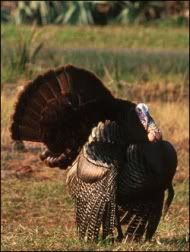
The Florida wild turkey is smaller and darker in color than the eastern wild turkey and also has less white veining in the wing quills. The white bars in the primary feathers are narrow, irregular, broken and do not extend all the way to the feather shaft, while secondary wing feathers are a darker brown. The pattern does not form triangular patches as does the Eastern’s feathers. The dark colors of the tail coverts (smaller feathers at the base of the tail) and the brown-tipped large tail feathers resemble those of the Eastern.
Average Weight Range
Adult Florida wild turkeys weigh six to over 16 pounds.
Reproduction
The breeding cycle for the Florida wild is slightly earlier than the eastern wild, usually in February. However, turkeys can start gobbling as early as January in southern parts of Florida. Egg laying starts in April, and hatching usually occurs in May. Males exhibit both gobbling and strutting to attract females. Gobbling attracts the hen to the male, who then courts the female by strutting. If the gobbler is successful, the female will crouch to signal the male to begin copulation. The first peak time for gobbling occurs at the beginning of breeding season when gobblers are searching for hens. The second peak begins a few weeks later, when most hens begin incubation. Gobblers usually mate with several hens, and it is generally the adult males who do most of the mating. Hens lay anywhere from 10 to 12 eggs per clutch, averaging about 28 days for incubation.
Food Usage/Selection
Wild turkeys are omnivores, eating a variety of plant and animal matter wherever and whenever available. Poults, or young turkey, eat large quantities of insects and other animal matter to get the needed protein for rapid development. As turkeys age, plant matter becomes the primary food source with about 90 percent of the mature turkey’s diet including the green foliage of grasses, vines, forbs, acorns, buds, seeds and various fruits.
Range
The Florida bird is indigenous to the Florida peninsula.
Habitat
The Florida turkey inhabits the Florida swamplands and prefers a moist, marshy environment.
Common Hunting Methods
The shotgun, bow and arrow, and black powder are all used to hunt turkey. To attract turkeys, hunters use a wide range of calls to the turkey or to induce gobblers to fight. Calling has become so popular that contests are held each year so experts and novices alike can fine-tune their skills.
Hunting Challenges/Values
With their excellent eyesight and well-developed sense of hearing, the turkey can sometimes outsmart decoys used by hunters as they become more and more sensitized to their presence. Wild turkeys are very good to eat and can be smoked, fried or baked. Many hunters proudly display their colorful capes, beards or full-bodied mounts.
Interesting Tidbits
Turkeys will answer thunder from an approaching storm with calls of their own.
Hens produce droppings in shapes like a mound, and the gobbler’s droppings are in a straight line or resemble the letter “J.”
Named for the famous Seminole Chief Osceola, who led a war against Americans in 1835.
Read about other Turkey subspecies:
Eastern Wild Turkey
Gould's Turkey
Merriam's Turkey
Ocellated Turkey
Osceola/Florida Turkey
Rio Grande Turkey
Interesting Economic Facts About Turkey Hunters
Turkey hunters are a special breed, turkey hunters are on the rise, and the most amazing thing of all is turkey hunters are big, big, big spenders. Here are a few facts about the economic contributions of turkey hunters.
1. If spring turkey hunters had their own state, they'd represent the nation's 35th largest state.
2. A spring turkey hunter spends an average of $784.38 on spring turkey hunting each year. (I have spent about $700 already this year.)
3. Spring turkey hunter's dollars provide jobs for 41,323 people who generate almost $200 million in federal income taxes.
4. The total number of jobs supported by spring turkey hunting in the United States is enough to completely eliminate unemployment in the states of Nebraska, New Hampshire or Idaho.
5. The jobs supported by spring turkey hunting are nearly 50 percent larger than the number of employees of U.S. Airways, a Fortune 500 company.
6. The federal income tax revenues generated from spring turkey hunting activities in the United States would pay the salaries and allowances for more than 5,600 U.S. soldiers.
We are not just passionate about this sport, we are obsessed with it. The camouflage, the guns, the spring weather, the gobbling turkeys, the thrill of calling them in, the excitement of the kill, and the good times and memories associated with every hunting experience makes hunting one of the greatest sports in the U.S.
I certainly hope that turkey hunting continues to be a passion and an obsession in the lives of hunters and that it is something that is passed down from generation to generation throughout the years. If you've been hunting already this spring I would love to hear your stories in the comments below!
Tuesday, July 04, 2006
Ocellated Turkey (Meleagris ocellata)
 Physical Description
The ocellated species is easily distinguished from the other North American subspecies primarily because its legs are shorter and thinner than other species. Tail feathers are bluish gray with a well-defined eye-shaped blue bronze colored spot near the end followed by a bright gold tip. The name is derived from the resemblance of the tail feathers’ spots to an eye (oculus). Both sexes have a blue colored head and neck with distinctive orange-to-red, warty, carnucle-like growths called nodules. These growths are more prominent on gobblers. The head of the male also has a fleshy blue crown behind the snood, which has nodules similar to those on the neck. The bird also has a distinct eye ring of bright red colored skin especially visible on the tom during breeding season. Neither toms nor hens of this species have beards, and breast feathers do not differ between males and females.
Average Weight Range
Adult ocellated turkeys weigh from six to 12 pounds.
Reproduction
Breeding occurs during the spring and summer months (May through August). The increase of daylight hours in spring triggers hormonal changes. Gobbling is used to attract receptive females for mating in late February to early March. Males exhibit both gobbling and strutting to attract females. Gobbling attracts the hen to the male, who then courts the female by strutting. If the gobbler is successful, the female will crouch to signal the male to begin copulation. The first peak time for gobbling occurs at the beginning of breeding season when gobblers are searching for hens. The second peak begins a few weeks later, when most hens begin incubation. Gobblers usually mate with several hens, and it is generally the adult males who do most of the mating. Hens lay anywhere from 8 to 12 eggs per clutch, averaging about 28 days for incubation.
Food Usage/Selection
Wild turkeys are omnivores, eating a variety of plant and animal matter wherever and whenever available. Poults, or young turkey, eat large quantities of insects and other animal matter to get needed protein for development. As turkeys age, plant matter becomes the primary food source with about 90 percent of the mature turkey’s diet including the green foliage of grasses, vines, forbs, acorns, buds, seeds and various fruits.
Range
The Ocellated turkey inhabits Central America and parts of Mexico’s Yucatan Peninsula.
Habitat
The ocellated turkey exists only in a 50,000 square mile area in the Yucatan peninsula range in southeastern Mexico including the states of Quintana Roo, Compeche, Peten, and Yucatan, also, southern Tabasco and northeastern Chiapas. It prefers brushy areas near streams and rivers or mesquite, pine, and scrub forests
Common Hunting Methods
The shotgun, bow and arrow, and black powder are all used to hunt turkey. To attract turkeys, hunters use a wide range of turkey calls to lure the turkey or to induce gobblers to a fight. Calling has become so popular that contests are held each year so experts and novices alike can fine-tune their skills.
Hunting Challenges/Values
With their excellent eyesight and well-developed sense of hearing, the turkey can sometimes outsmart decoys used by hunters as they become more and more sensitized to their presence. Wild turkeys are very good to eat and can be smoked, fried or baked. Many hunters proudly display their colorful capes, beards or full-bodied mounts.
Interesting Tidbits
Turkeys will answer thunder from an approaching storm with calls of their own.
Turkey hunting is one of the most popular forms of hunting.
Hens produce droppings in shapes like a mound, and the gobbler’s droppings are in a straight line or resemble the letter “J.”
It is also known by these names, depending on its Central America location: pavo, pavo ocelado, or the Mayan Indian ucutz il chican.
Read about other Turkey subspecies:
Eastern Wild Turkey
Gould's Turkey
Merriam's Turkey
Ocellated Turkey
Osceola/Florida Turkey
Rio Grande Turkey
Merriam's Turkey (Meleagris gallopavo merriami)
 Physical Description
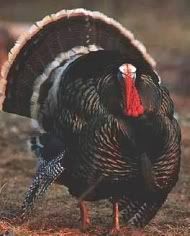
Although approximately the same size as the Eastern, the Merriam has different coloration. It is black with blue, purple and bronze reflections. White feathers on the lower back and tail feather margins distinguish the Merriam from other subspecies of turkey. The margins have a dull white appearance. Merriam’s appear to have a white rump due to pinkish buff, or whitish tail coverts and tips. The tail feathers are very conspicuous when the gobbler struts against a dark background. Toms have black-tipped breast feathers, while the hens exhibit buff tips. Hens have a more extensive white area on the wings giving a whiter appearance when the wings are folded.
Average Weight Range
Mature Merriam wild turkeys weigh from eight to over 20 pounds.
Reproduction
Breeding occurs during the spring and summer months (May through August). The increase of daylight hours in spring triggers hormonal changes. Gobbling is used to attract receptive females for mating in late February to early March. Males exhibit both gobbling and strutting to attract females. Gobbling attracts the hen to the male, who then courts the female by strutting. If the gobbler is successful, the female will crouch to signal the male to begin copulation. The first peak time for gobbling occurs at the beginning of breeding season when gobblers are searching for hens. The second peak begins a few weeks later, when most hens begin incubation. Gobblers mate with several hens, and it is generally the adult males who do most of the mating. Hens lay anywhere from 8 to 12 eggs per clutch, averaging about 28 days for incubation.
Food Usage/Selection
Wild turkeys are omnivores, eating a variety of plant and animal matter wherever and whenever available. Poults, or young turkey, eat large quantities of insects and other animal matter to get needed protein for development. As turkeys age, plant matter becomes the primary food source with about 90 percent of the mature turkey’s diet including the green foliage of grasses, vines, forbs, acorns, buds, seeds and various fruits.
Range
The Merriam is found in the ponderosa pine forests of Arizona, New Mexico, Colorado, and the rest of the Rocky Mountain range, and has been transplanted to Nebraska, Washington, California, Oregon, and the Canadian provinces of Alberta and Manitoba.
Habitat
Merriam’s wild turkeys inhabit ponderosa pine forests, western mountainous regions of the United States and the woodland prairies. Merriam’s tend to live in regions that receive annual rainfall of 15 to 23 inches.
Common Hunting Methods
The shotgun, bow and arrow, and black powder are all used to hunt turkey. To attract turkey, hunters use a wide range of calls to lure them or to induce gobblers to a fight. Calling has become so popular that contests are held each year so experts and novices alike can fine-tune their skills.
Hunting Challenges/Values
With their excellent eyesight and well-developed sense of hearing, the turkey can sometimes outsmart decoys used by hunters as they become more and more sensitized to their presence. Wild turkeys are very good to eat and can be smoked, fried or baked. Many hunters proudly display their colorful capes, beards or full-bodied mounts.
Interesting Tidbits
Turkeys will answer thunder from an approaching storm with calls of their own.
Turkey hunting is one of the most popular forms of hunting.
Hens produce droppings in shapes like a mound, and the gobbler’s droppings are in a straight line or resemble the letter “J.”
Named for C. Hart Merriam, who was the first chief of the U. S. Biological Survey.
Read about other Turkey subspecies:
Eastern Wild Turkey
Gould's Turkey
Merriam's Turkey
Ocellated Turkey
Osceola/Florida Turkey
Rio Grande Turkey
Gould's Turkey (Meleagris gallopavo mexicana)
 Physical Description
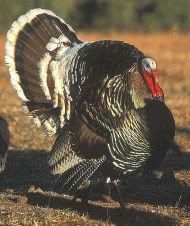
Gould’s Turkey is the largest of the five North American subspecies. It also has longer legs, larger feet, and larger center tail feathers than other wild turkey. White tips on the tail feathers and tail coverts, which usually separate to exhibit an “eyelash” appearance, distinguish Gould’s from other turkeys. The body plumage is blue-green in color and the lower back and rump feathers have copper and greenish-golden reflections unlike the faintly iridescent velvety black of the Merriam’s. Hens have a less pronounced metallic green and red sheen and are more purplish in color.
Average Weight Range
Mature Gould’s wild turkeys weigh eight to over 25 pounds.
Reproduction
Gobbling activity for the Gould’s occurs from April to June in association with plant growth in its habitat. The increase of daylight hours in also spring triggers hormonal changes. Males exhibit both gobbling and strutting to attract females. Gobbling attracts the hen to the male, who then courts the female by strutting. If the gobbler is successful, the female will crouch to signal the male to begin copulation. The first peak time for gobbling occurs at the beginning of breeding season when gobblers are searching for hens. The second peak begins a few weeks later, when most hens begin incubation. Gobblers usually mate with several hens, and it is generally the adult males who do most of the mating. Hens lay anywhere from 8 to 12 eggs per clutch, averaging about 28 days for incubation.
Food Usage/Selection
Wild turkeys are omnivores, eating a variety of plant and animal matter wherever and whenever available. Poults, or young turkey, eat large quantities of insects and other animal matter to get needed protein for development. As turkeys age, plant matter becomes the primary food source with 90 percent of the mature turkey’s diet including the green foliage of grasses, vines, forbs, acorns, buds, seeds and various fruits.
Range
Gould’s can be found in small numbers in Arizona and New Mexico but is abundant in northwestern regions of Mexico. They inhabit mountainous terrain found in the Sierra Madre Occidental Mountains of Mexico, the Animas and San Luis Mountains of New Mexico and in the Peloncillo Mountains of New Mexico and Arizona.
Habitat
Gould’s utilize areas of underbrush, along creek beds or other areas of thick brush with scattered openings in mountainous regions.
Common Hunting Methods
The shotgun, bow and arrow, and black powder are all used to hunt turkey. To attract turkeys, hunters use a wide range of turkey calls to lure the turkey or to induce gobblers to a fight. Calling has become so popular that contests are held each year so experts and novices alike can fine-tune their skills.
Hunting Challenges/Values
With their excellent eyesight and well-developed sense of hearing, the turkey can sometimes outsmart decoys used by hunters as they become more and more sensitized to their presence. Wild turkeys are very good to eat and can be smoked, fried or baked. Many hunters proudly display their colorful capes, beards or full-bodied mounts.
Interesting Tidbits
Turkeys will answer thunder from an approaching storm with calls of their own.
Turkey hunting is one of the most popular forms of hunting.
Hens produce droppings in shapes like a mound, and the gobbler’s droppings are in a straight line or resemble the letter “J.”
They are the least known of the turkey subspecies, first described by J. Gould during his travels in Mexico.
Read about other Turkey subspecies:
Eastern Wild Turkey
Gould's Turkey
Merriam's Turkey
Ocellated Turkey
Osceola/Florida Turkey
Rio Grande Turkey
Eastern Turkey (Meleagris gallopavo silvestris)
 Physical Description
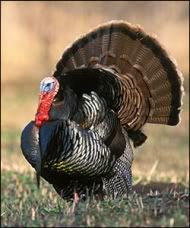
Chestnut brown-tipped tail coverts (smaller feathers which cover up larger ones) and dark-buff or chocolate-brown tail tips characterize the most abundant and most widely hunted turkey, the Eastern Wild Turkey. The tom turkey’s breast feathers are tipped in black, while other body feathers are colored with copper or bronze metallic iridescence. The primary wing feathers have white and black bars that extend to the feather shaft, while the secondary wing feathers mainly have prominent white bars. This results in a white triangular area on each side of the back when the wings are folded backward. Hens are browner with less brilliant iridescence and the breast feathers are tipped in buff or chestnut. The Eastern tom and hen generally can grow up to four feet in height.
Average Weight Range
The mature Eastern Wild Turkey weighs from eight to 25 pounds, with some individual toms topping 30 pounds.
Reproduction
Breeding occurs during the spring and summer months, usually starting in late February or early March in southern states. Breeding won’t occur until April in northern states such as Vermont and other northernmost areas. The cycle is complete with the hatching of poults in summer. The increase of daylight hours in spring triggers hormonal changes. Males exhibit both gobbling and strutting to attract females. Gobbling attracts the hen to the male with specific mating calls. The male will then court the female by strutting back and forth. If the gobbler is successful, the female will crouch to signal the male to begin copulation. The first peak time for gobbling occurs at the beginning of breeding season when gobblers are searching for hens. The second peak begins a few weeks later, when most hens begin incubation. Gobblers usually mate with several hens, and it is generally the adult males who do most of the mating. Hens lay anywhere from 8 to 12 eggs per clutch, averaging about 28 days for incubation.
Food Usage/Selection
Wild turkeys are omnivores, eating a variety of plant and animal matter wherever and whenever available. Poults eat large quantities of insects and other animal matter to get needed protein for development. As turkeys age, plant matter becomes the primary food source. About 90 percent of the mature turkey’s diet comes from plants, including green foliage of grasses, vines, forbs, acorns, buds, seeds, various fruits and waste grain from agricultural crops.
Range
The Eastern Wild Turkey inhabits the eastern half of the U.S., and can be found in hardwood and mixed forests from New England and southern Canada to northern Florida and west to Texas, Missouri, Kansas, Iowa, and Minnesota, however, it has been transplanted in California, Oregon, and Washington and other areas west of the Rocky Mountains.
Habitat
The Eastern turkey, which has adapted to many habitats, utilizes both hardwood and softwood forests, open pastures, and agricultural fields.
Common Hunting Methods
The shotgun, bow and arrow, and black powder are all used to hunt turkey. Rifles are also allowed in some states. Hunters use a wide variety of calls to attract turkeys within shooting range. Calling has become so popular that contests are held each year so experts and novices alike can fine-tune their skills.
Hunting Challenges/Values
With their excellent eyesight and well-developed sense of hearing, turkeys are constantly aware of their surroundings. The turkey can sometimes outsmart hunters who use decoys as they become more and more sensitized to their presence. Wild turkeys are very good to eat and can be smoked, fried or baked. Many hunters proudly display their colorful capes, beards or full-bodied mounts.
Interesting Tidbits
Turkeys will answer thunder from an approaching storm with a shock gobble.
Turkey hunting is one of the most popular forms of hunting.
Hens produce droppings in shapes like a mound, and the gobbler’s droppings are in a straight line or resemble the letter “J.”
Read about other Turkey subspecies:
Eastern Wild Turkey
Gould's Turkey
Merriam's Turkey
Ocellated Turkey
Osceola/Florida Turkey
Rio Grande Turkey
Subscribe to:
Posts (Atom)
